
 how-to
Signs Your Windshield Needs Professional Repair
Table of Contents
- How to Tell If Your Windshield Can Be Repaired
- 7 Warning Signs Your Windshield Needs Professional Repair
- Windshield Chip Repair vs Replacement: Which Do You Need?
- How Long Does Windshield Repair Take?
- Windshield Camera Recalibration Requirements After Replacement
- Conclusion
- Frequently Asked Questions
Last Updated: September 12, 2026
How to Tell If Your Windshield Can Be Repaired
Most chips and cracks are repairable if you act quickly. A windshield chip is a small area of impact damage in the glass, typically smaller than a quarter, that has not yet penetrated through both layers. The rule of thumb technicians use: if the damage is smaller than a dollar bill and away from the edges, repair is usually possible. At BL Auto Glass, we assess damage in person because size alone does not tell the full story. The location of the damage, its depth, and whether moisture has entered the break all affect the outcome.
Modern windshields are made of laminated glass, two layers bonded around a plastic interlayer. That interlayer is what stops a small chip from becoming a hole. It also means damage that stays in the outer layer can often be filled with resin injection rather than replaced. The National Highway Traffic Safety Administration guidance on vehicle glazing treats the windshield as a structural safety component, not just a window, which is why repair decisions matter beyond appearance.
The Dollar-Bill Rule and Quarter-Sized Limit
The dollar-bill rule is a quick field test: if the damage fits under a dollar bill, it is usually a repair candidate (nhtsa.gov). Anything larger than a quarter in diameter typically calls for replacement. This matters because windshield replacement is not always necessary, and unnecessary replacement costs more and takes longer.
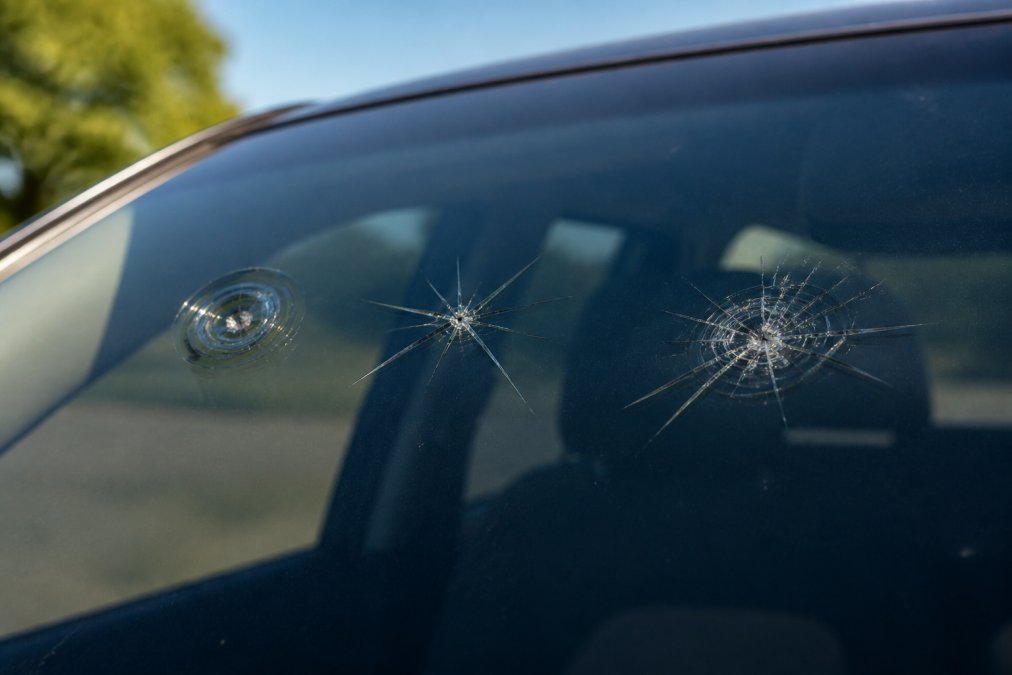
Visual Identification Guide: Bullseye, Star, and Combination Breaks
Before you call anyone, look at the shape of the impact. The pattern tells you more about repairability than size alone, and it is the fastest way to self-diagnose.
- Bullseye break. A circular impact with a dark center and one or more concentric rings around it, like a target. The rings are the glass separating from the interlayer. Bullseyes under a quarter, away from the edges, are the most predictable repair candidate because the damage is contained and the resin can flow into the cone-shaped void.
- Star break. Legs radiate outward from the impact point, usually four to eight of them. The legs are short cracks running along the surface. A star with short, tight legs repairs well; a star with long legs that reach toward the edge is a replacement case because the legs will keep running.
- Combination break. A bullseye and a star in the same impact, a dark center with radiating legs. These run deeper than either pattern alone and are the most likely to need replacement, especially once the legs exceed an inch or two.
- Pit or nick. A small surface divot with no radiating damage. Often cosmetic, but a pit that sits in the driver's line of sight can scatter light at night.
- Hairline crack. A thin line with no visible impact point. Hairlines spread with temperature and vibration and are rarely a good repair candidate once they exceed a few inches.
- Edge crack. Any damage within a few inches of the windshield border. The edge carries structural load, so this is almost always a replacement.
Why Shape Matters More Than Size
A quarter-sized bullseye and a quarter-sized combination break are not the same problem. The bullseye's damage is contained in a cone; the combination break's legs are already running through the glass. Resin injection fills a void, it does not stop a running crack. That is why a technician who only measures diameter will sometimes promise a repair that fails a week later. When you describe your damage over the phone, describe the shape, not just the size.
When to Ignore a Chip vs. When to Act
A small pit outside the driver's line of sight, with no legs and no dark center, can often wait, but not indefinitely. The practical rule most technicians use: if the damage is under a quarter, away from the edges, out of the driver's view, and has not changed in a week, it is a low-urgency repair. If any of those conditions is false, treat it as urgent. The cost of a repair is a fraction of a replacement, so the downside of acting early is small and the downside of waiting is a full replacement.
7 Warning Signs Your Windshield Needs Professional Repair
Seven specific signs tell you when to stop driving on a damaged windshield and get a professional assessment. Catching these early usually means a repair instead of a full replacement.
1. Chips Larger Than a Quarter
Damage wider than a quarter has usually compromised the glass beyond what resin can stabilize. A chip this size weakens the surrounding area, and temperature fluctuations accelerate the spread. Get it assessed before it grows.
2. Cracks in the Driver's Line of Sight
Any crack directly in the driver's line of sight is a visibility obstruction and a safety hazard. Even a thin hairline crack in that zone distorts light at night and in rain. Most technicians recommend replacement here regardless of size.
3. Edge Damage and Structural Integrity
Damage within a few inches of the windshield edge is a replacement case almost every time. The edges carry the glass's structural load, and a crack there can compromise auto glass integrity quickly. This is where the windshield bonds to the frame, so edge damage is never a simple fill.
4. Cracks That Are Spreading
A crack that has grown since you first noticed it is spreading, and spreading cracks rarely stop on their own. Vibration, temperature swings, and road flex all push it further. Once a crack exceeds a few inches, repair is off the table.
5. Penetration Depth Beyond the Outer Layer
If the impact point has penetrated past the outer glass layer into the interlayer, resin injection cannot restore the strength. You can often tell by feel or by a deep, dark center in the break. Deep penetration means replacement.
6. Moisture or Dirt Inside the Break
Once moisture ingress or dirt gets into a break, the resin cannot bond properly. You will see a dark or cloudy tint inside the chip. This is a common reason a repair that looked simple turns into a replacement.
7. Surface Pitting That Obscures Vision
Surface pits from road debris scatter light and create glare, especially driving into a low sun. Heavy pitting across the windshield is a visibility problem that polishing alone will not fix. If pitting obscures your view, replacement is the practical answer.
Windshield Chip Repair vs Replacement: Which Do You Need?
Repair is the right choice for small, shallow damage away from the edges and out of the driver's line of sight. Replacement is the right choice for large damage, edge damage, deep penetration, or anything affecting visibility. The Federal Motor Vehicle Safety Standards on glazing materials set the performance requirements windshields must meet, and a repaired windshield must still satisfy them.
| Damage Type | Size or Location | Recommended Action |
|---|---|---|
| Bullseye chip | Under a quarter, away from edges | Resin repair |
| Star break | Small, not spreading | Resin repair |
| Combination break | Any size, deep legs | Replacement |
| Edge crack | Within a few inches of edge | Replacement |
| Line-of-sight crack | Driver's view zone | Replacement |
| Moisture-filled chip | Dark or cloudy center | Replacement |
| Heavy surface pitting | Across the windshield | Replacement |
The Cost-Benefit Math
A resin repair is almost always the cheaper path, and the gap is large enough that it changes the decision. A single-chip repair typically runs a fraction of the cost of a full replacement, and it takes under an hour instead of most of a day. The trade-off is that repair restores function, not appearance, a filled chip leaves a faint mark, and a technician cannot promise the glass will look factory-new. Replacement restores both function and appearance but costs more, takes longer, and on modern vehicles usually triggers a camera recalibration step (see below).
A common pattern: a driver waits on a small chip to save money, the chip spreads in a cold snap or a hot afternoon, and the eventual replacement costs several times what the original repair would have. The repair is the low-risk option; waiting is the expensive one.
How Insurance Usually Handles Glass Claims
Glass coverage varies more than most drivers expect, so it is worth checking your policy before you assume you are paying out of pocket.
- Comprehensive coverage. Windshield damage from road debris, weather, or vandalism is typically handled under the comprehensive portion of a policy, not collision. If you have comprehensive, glass damage is often covered.
- Deductibles. Many policies apply your comprehensive deductible to a glass claim, which can exceed the cost of a simple repair. Some insurers waive the deductible for repair (not replacement) to encourage fixing small chips early, ask specifically whether repair is deductible-free on your policy.
- State rules. A handful of states require insurers to offer or provide glass coverage without a separate deductible. Rules differ by state, so confirm what applies where you live.
- Filing mechanics. A glass claim is usually separate from an at-fault accident claim and generally does not affect your premium the way an accident does. The shop typically bills the insurer directly and you pay only the deductible, if any.
Why Replacement Triggers a Recalibration Step
If your vehicle has driver-assist features, lane-keeping, automatic emergency braking, adaptive cruise, the forward-facing camera is mounted to the windshield. A new windshield changes the camera's aim, so the system must be recalibrated after replacement. This is not optional, and it is a real cost difference between repair and replacement on modern cars. A repair that leaves the original glass in place does not trigger recalibration; a replacement does. That single fact often tips the decision toward repair when the damage qualifies.
How Long Does Windshield Repair Take?
Windshield repair typically takes 30 to 60 minutes for a single chip, and you can usually drive within an hour. The resin needs time to cure, but the process itself is quick. Replacement takes longer, often two to three hours, because the urethane adhesive must set to a safe drive-away strength. Mobile service adds travel time but saves you a trip.
What most guides miss is that repair time depends on how many impact points you have. Three chips take longer than one, and each one is assessed and filled separately. A technician who rushes a multi-chip repair risks a weak bond.
Windshield Camera Recalibration Requirements After Replacement
Windshield camera recalibration is required after replacement on any vehicle with driver-assist features like lane-keeping or automatic braking. The camera mounts to the glass, so a new windshield changes its aim. Without recalibration, those systems can misread the road.
There are two methods. Static recalibration uses targets placed in front of the vehicle in a controlled space. Dynamic recalibration requires driving the vehicle at specified speeds so the system can relearn. Which method applies depends on the automaker's procedure. This step is not optional, and skipping it leaves safety systems unreliable. BL Auto Glass includes camera recalibration when your vehicle needs it, so the systems work as designed after the new glass goes in.
Conclusion
A damaged windshield is a safety issue, not a cosmetic one, and the decision between repair and replacement comes down to size, location, and depth. The sooner you get it assessed, the more likely a quick repair will do. BL Auto Glass handles mobile repair and replacement, manages your insurance claim from start to finish, and includes camera recalibration when needed, backed by a lifetime warranty and same-day appointments. Book now with BL Auto Glass and get your windshield restored safely.
Frequently Asked Questions
How to tell if your windshield can be repaired?
A windshield can typically be repaired if the damage is smaller than a quarter and not in the driver's direct line of sight. Cracks longer than a dollar bill or those that penetrate deeply may require replacement. Repairable damage includes bullseye, star, and combination breaks. If the chip is on the edge or has moisture inside, replacement is often necessary. A professional inspection is the best way to determine repairability.
At what point is a windshield crack considered non-repairable?
A crack is usually non-repairable if it exceeds 6 inches, spreads into the edge, or is in the driver's primary viewing area. Cracks that have been exposed to moisture or dirt for a long time also cannot be repaired effectively. Additionally, if the damage penetrates both layers of the laminated glass, replacement is required. For these cases, a full windshield replacement restores structural integrity and safety.
Does a small chip in the windshield require immediate professional repair?
Yes, a small chip should be repaired promptly. Temperature fluctuations and road vibrations can cause a chip to spread into a large crack within days. Repairing early is faster, less expensive, and preserves the original windshield. Many insurance companies cover chip repair at no cost. If you notice a chip, schedule a professional repair as soon as possible to avoid a full replacement.
How does temperature affect windshield crack expansion?
Temperature swings cause the glass to expand and contract, which can make existing cracks spread. In hot weather, the glass expands; in cold, it contracts. This stress can turn a small chip into a long crack quickly. Parking in shaded areas and avoiding sudden temperature changes can help slow the process, but professional repair is the only permanent fix. If you live in an area with extreme temperature changes, address windshield damage immediately.
Sources referenced in this article:
- National Highway Traffic Safety Administration vehicle glazing guidance
- Federal Motor Vehicle Safety Standards on glazing materials
- Insurance Information Institute guidance on auto glass claims