
 how-to
Windshield Camera Recalibration After Replacement Explained
Table of Contents
- What Windshield Camera Recalibration Actually Means
- Signs Your ADAS Needs Recalibration After a Replacement
- Static vs Dynamic ADAS Calibration: Which One Does Your Car Need?
- How Long Does Windshield Camera Calibration Take?
- What Happens During the Windshield Camera Recalibration Process
- DIY vs. Professional Recalibration: Why the Risk Gap Is Wide
- Cost Transparency: What Affects Recalibration Pricing
- Conclusion
Last Updated: August 17, 2026
What Windshield Camera Recalibration Actually Means
Windshield camera recalibration is the process of realigning a vehicle's forward-facing camera system to factory-specified tolerances after the windshield has been removed and replaced. The camera doesn't just need to be physically remounted, its viewing angle, focal reference points, and sensor orientation must all be re-established according to the original equipment manufacturer's exact specifications.
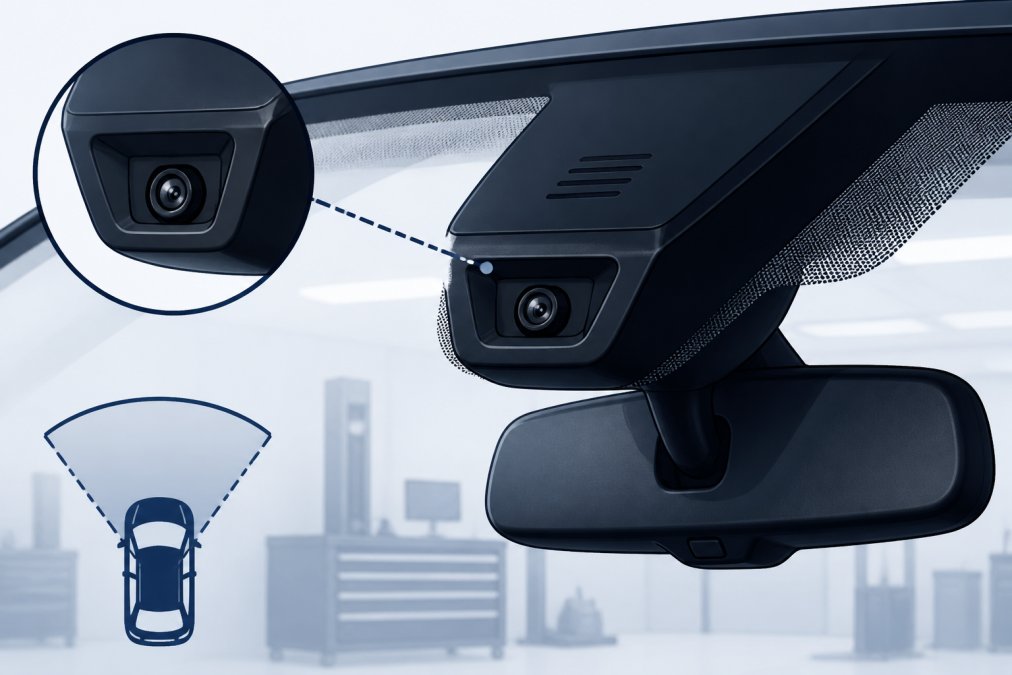
At BL Auto Glass, windshield camera recalibration is included when needed as part of the replacement process, because a new windshield without a properly calibrated camera is a safety problem, not a finished job.
How the Forward-Facing Camera Works
Most modern vehicles equipped with Advanced Driver Assistance Systems rely on a forward-facing camera mounted directly behind the windshield, typically near the rearview mirror bracket. This camera is the primary sensor for systems like Lane Departure Warning, Automatic Emergency Braking, and Adaptive Cruise Control.
The camera interprets the road environment through the windshield glass itself. That means optical clarity, the angle of the glass, and the precise positioning of the sensor housing all directly affect what the camera "sees." Even a small deviation from the OEM-specified mounting angle can cause the system to misread lane markings or fail to detect a vehicle ahead in time.
Why Windshield Replacement Disrupts Sensor Alignment
Here's what most people don't realize: removing a windshield breaks the fixed reference point the camera depends on. The original glass was installed with the camera bracket bonded at a precise position. When that glass comes out, the camera must come with it, and when the new windshield goes in, the bracket and camera are repositioned.
No matter how skilled the installer, manual repositioning cannot achieve the sub-millimeter tolerance levels that ADAS systems require. According to the National Highway Traffic Safety Administration's guidance on ADAS safety systems, these systems are classified as safety-critical, which means their calibration must meet strict vehicle manufacturer guidelines, not just approximate alignment.
Signs Your ADAS Needs Recalibration After a Replacement
The most obvious sign is a warning light on your instrument cluster, typically labeled "ADAS," "Camera Unavailable," or a lane-keeping symbol. But the absence of a warning light does not mean the system is calibrated correctly.
Other signs your ADAS needs recalibration include:
- Lane Departure Warning that triggers on straight, clearly marked roads
- Adaptive Cruise Control that brakes unexpectedly or fails to maintain following distance
- Forward collision alerts that fire at incorrect distances
- A camera display showing an image that appears tilted or misaligned
- Any ADAS-related error code retrieved during a diagnostic scan
A common mistake is assuming that if the car "drives fine," the camera is aligned. Many calibration errors fall within a range that doesn't produce obvious driving symptoms, but still represents a meaningful deviation from OEM specifications. The only reliable way to confirm correct alignment is a post-calibration validation using a diagnostic scan tool.
Static vs Dynamic ADAS Calibration: Which One Does Your Car Need?
Static vs dynamic ADAS calibration is one of the most misunderstood aspects of the recalibration process. The short answer: your vehicle's make and model determines which method is required, and in some cases, both are necessary.
Static Calibration: Controlled Environment, Calibration Targets
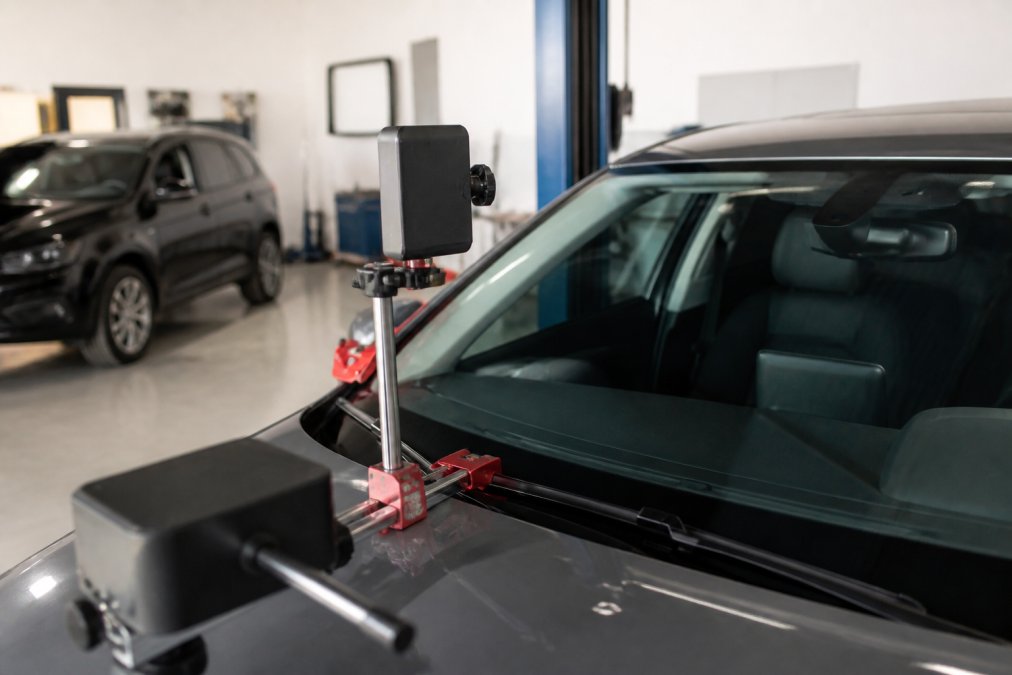
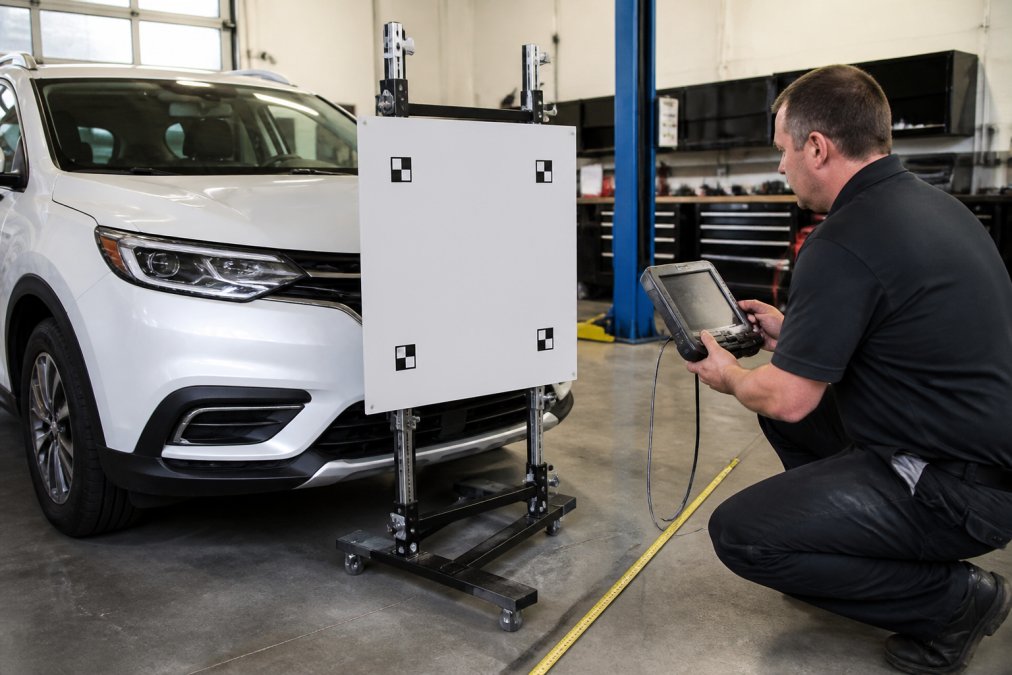
Static calibration is performed with the vehicle stationary in a controlled environment. A technician positions calibration targets, large, precisely printed boards, at specific distances and angles in front of the vehicle, following OEM specifications to the centimeter. The calibration software then uses these targets to establish the camera's reference frame.
This method requires a flat, level surface with adequate space and controlled lighting. Performing static calibration in a parking lot or driveway is not a viable substitute for a properly equipped shop. The measurement precision required is genuine, even a slightly uneven floor or incorrect target distance will produce an inaccurate calibration.
Dynamic Calibration: Road Test at Speed
Dynamic calibration is performed while driving. Once the system is initialized, the vehicle must be driven at a specified speed, often highway speeds, for a set distance, on roads with clear lane markings. The camera uses real-world road data to complete its system initialization.
Some vehicles require dynamic calibration alone; others require static first, then dynamic. The vehicle manufacturer's technical service bulletin for your specific model is the definitive source for which method applies. A shop that offers only one method without checking OEM specifications is cutting corners.
| Calibration Type | Where It Happens | What's Required | Typical Vehicles |
|---|---|---|---|
| Static | Indoor shop, controlled environment | Calibration targets, level floor, calibration software | Many European and domestic makes |
| Dynamic | Public road at speed | Clear lane markings, highway conditions | Many Japanese makes; some domestic |
| Both (combined) | Shop, then road | Full static setup plus road test | Increasing number of 2022+ models |
How Long Does Windshield Camera Calibration Take?
Windshield camera calibration typically takes between 30 minutes and two hours, depending on the method required and the vehicle. Static calibration alone often runs 45 to 90 minutes. Dynamic calibration adds a road test of 20 to 45 minutes on top of any static procedure.
The total time from windshield removal to completed recalibration, including adhesive cure time, is generally three to four hours for most passenger vehicles. Some newer vehicles with more complex ADAS configurations take longer.
One thing that extends the process unnecessarily: starting calibration before the windshield adhesive has fully cured. The vehicle must be stable and the glass fully bonded before any calibration begins, because even minor flex in the glass during the process can corrupt the result.
What Happens During the Windshield Camera Recalibration Process
The recalibration process follows a defined sequence. Skipping or rushing any step compromises the accuracy of the result.
Step 1: Diagnostic Scan and System Initialization
The technician connects a diagnostic scan tool to the vehicle's OBD-II port and pulls any stored fault codes related to the ADAS. This baseline scan identifies whether the camera system has flagged errors and confirms the system is ready to accept calibration inputs. Some vehicles require a specific initialization sequence through the calibration software before any physical target placement begins.
Step 2: Camera Orientation and Target Placement
For static calibration, the technician measures the vehicle's position on the shop floor and places calibration targets at OEM-specified distances, typically using the vehicle's centerline and front axle as reference points. This is precise, methodical work. The target boards must be positioned within tight tolerances, and the camera's orientation is adjusted until the software confirms alignment within acceptable parameters.
For dynamic calibration, this step is replaced by a road test at specified speeds on roads with clear lane markings, allowing the camera to complete its self-alignment sequence.
Step 3: Post-Calibration Validation
Post-calibration validation is the step that separates a thorough job from a rushed one. After calibration is complete, the technician runs a second diagnostic scan to confirm no fault codes remain and that all ADAS systems are reporting normal status. Some shops also perform a short drive cycle to verify that Lane Departure Warning and Automatic Emergency Braking are operating correctly before returning the vehicle.
This verification step is documented, a record of the pre- and post-calibration scan results gives the vehicle owner proof that the system was properly recalibrated, which matters for insurance purposes and future service records.
According to IIHS research on ADAS system effectiveness, systems like Automatic Emergency Braking and Lane Departure Warning significantly reduce crash rates, but only when they are functioning correctly. A miscalibrated system provides none of that protection.
DIY vs. Professional Recalibration: Why the Risk Gap Is Wide
Some online forums suggest that dynamic calibration can be completed by simply driving the car after a windshield replacement. This is the most dangerous misconception in the ADAS space right now.
Dynamic calibration requires the system to be in a specific initialized state before the road test begins. Without the diagnostic scan tool step and proper system initialization, driving the vehicle doesn't complete calibration, it just drives the vehicle. The camera remains misaligned.
As for static calibration: the equipment alone puts it firmly out of DIY range. Calibration targets must be printed to exact specifications, positioned with millimeter-level accuracy, and read by manufacturer-specific calibration software connected to the vehicle. This is not a process that can be replicated with a smartphone app or generic OBD reader.
The risk gap between DIY attempts and professional recalibration isn't about effort or skill, it's about equipment access and the consequences of getting it wrong. A miscalibrated ADAS system in a vehicle operating at highway speeds is a genuine safety hazard. The AAA research on ADAS system failures has documented how improperly functioning driver assistance systems can increase rather than reduce collision risk.
Cost Transparency: What Affects Recalibration Pricing
Recalibration pricing varies based on several factors, and understanding them helps avoid surprises. BL Auto Glass includes camera recalibration when needed as part of the replacement service, contact the team directly for current pricing on your specific vehicle.
For context, here are the variables that drive cost differences across providers:
- Vehicle make and model: Luxury and European vehicles often require proprietary calibration software that costs more to license and operate
- Calibration method required: Combined static-plus-dynamic procedures take more time and equipment than single-method calibrations
- Shop equipment quality: Shops using OEM-grade calibration software and targets produce more reliable results than those using aftermarket alternatives
- Whether recalibration is bundled: Some providers charge separately for the diagnostic scan, the calibration itself, and the post-calibration validation, others bundle all three
One question worth asking any provider: does the quoted price include post-calibration validation and documentation? A calibration without a final scan confirmation is an incomplete service, regardless of the price.
Many comprehensive insurance policies cover ADAS recalibration as part of windshield replacement. Check your policy or ask your provider to confirm coverage before assuming it's an out-of-pocket expense. In Florida, comprehensive insurance holders are often able to get windshield replacement with zero deductible, and recalibration coverage may follow.
Vehicle-specific calibration requirements are the single biggest variable most consumers overlook. A 2019 sedan and a 2024 SUV from the same manufacturer may require completely different calibration procedures. Always verify requirements against the OEM technical service bulletin for your exact year, make, and model, not a generic guide for the brand.
Getting a windshield replaced without addressing camera recalibration is like replacing a broken smoke detector and leaving the battery out. The hardware is there, but the protection isn't. BL Auto Glass handles the full process, windshield replacement, ADAS camera recalibration when required, and post-calibration validation, with same-day mobile service and a lifetime warranty on the glass. The team manages insurance claims from start to finish, and comprehensive insurance holders frequently qualify for a $0 deductible under Florida law. Book now with BL Auto Glass and get back on the road with every safety system working exactly as your vehicle's manufacturer intended.
Frequently Asked Questions
Do I need to recalibrate my camera every time I get a windshield replaced?
Yes, if your vehicle has a forward-facing ADAS camera mounted to the windshield or its bracket, windshield camera recalibration is required after every replacement. Removing and reinstalling the windshield shifts the camera's angle, even slightly, which is enough to push Lane Departure Warning, Automatic Emergency Braking, and Adaptive Cruise Control outside OEM tolerance levels. Skipping it leaves those safety-critical systems operating on bad data.
What happens if I don't recalibrate after windshield replacement?
An uncalibrated ADAS camera can misread lane markings, fail to detect vehicles ahead, or trigger false alerts. Automatic Emergency Braking may activate when it shouldn't, or not activate when it should. Because the camera's field of view is off by even a fraction of a degree, collision avoidance calculations become unreliable. Vehicle manufacturer guidelines and most technical service bulletins treat recalibration as mandatory, not optional, following any windshield removal.
Is ADAS recalibration included in windshield replacement costs?
It depends on the provider. Some auto glass companies charge separately for recalibration; others include it. If you have comprehensive insurance, Florida law often results in a $0 deductible for windshield replacement, but coverage for recalibration varies by policy. Always confirm before the appointment whether calibration is included, and ask for post-repair verification documentation. Contact BL Auto Glass directly for current pricing details specific to your vehicle.
How do I know if my car has ADAS features that need recalibration?
Check your owner's manual under 'driver assistance systems' or look for a small camera housing near the rearview mirror at the top of your windshield. Features like Lane Departure Warning, Adaptive Cruise Control, and Automatic Emergency Braking all rely on a forward-facing camera. Most vehicles built after 2018 include at least one of these systems. A diagnostic scan tool can also confirm whether your vehicle's system initialization requires post-replacement recalibration.
This article was written using GrandRanker